Search More Animals

Custom Search
Showing posts with label Bird. Show all posts

Wednesday, March 27, 2013

Cockatoo


Beauty Of Animal | Cockatoo | Parrot and sulfur crested, Cacatua galerita, is a relatively large white parrot found in forested habitats in Australia and New Guinea. Can be very numerous and locally, leading them sometimes lesions that are being considered. It is well known in breeding birds, although it can be claimed pets.In Australia, can be found on the sulfur crested cockatoos on a large scale in the north and east, starting as far south as Tasmania, but avoid the interior arid with few trees. They are numerous in suburban habitats in cities such as Adelaide and Canberra, Sydney and Brisbane. With the exception of upland areas, they occur in most parts of New Guinea and neighboring small islands, such as Waigeo, Misool and Aru, and various islands in the Gulf and the Gulf of Cenderawasih Milne.

There are four breeds recognized; C g was found on the Triton (Temminck, 1849) in New Guinea and surrounding islands, C. (G) is limited elenora (Finsch, 1867) to the Aru Islands between Australia and New Guinea, C. (G) fitzroyi (Matthews, 1912) in northern Australia from Western Australia to the Gulf of Carpentaria and the nomination of the strains found from Cape York in the state of Tasmania.In Australia, sulfur crested cockatoos from the nomination race was introduced to Perth, which is now outside the normal range.

Outside Australia, that have been made to Singapore, where their numbers are estimated between 500 and 2000. As has been because they Palau and New Zealand. New Zealand has made the population less than 1000. Have been registered as such in the various islands and Alakija (such as the Kai Islands and Ambon), but it is not clear if he had managed to become there.It facility and a total length of 45-55 cm (18-22 inches), with the Australian strain is greater than strains from New Guinea and neighboring islands.

The total white feathers, while the underwing and tail tinged yellow. Summit expressive yellow. Black and gray bill, legs and eye ring is white. Males usually have almost black eyes, while females have more red or brown eye, but this needs to be seen to optimal viewing conditions. Differences between breeds and subtle. C. g fitzroyi similar to the nomination race, but lacks the yellow on the ear tufts and a little blueish skin around the eye. C, g g-like Eleonora C. fitzroyi but smaller and wider and feathers in the custom, and C (g) g Triton-like C. Eleonora but the smallest bill.It is similar in appearance to the three types of corellas exist in Australia. However, is the smallest corellas, lacking a prominent pale yellow top and her bills. In captivity, is easily confused with sulfur crested parrot, the parrot with a smaller yellow crowned parrot or blue eyes with a different form on the top and a darker blue eye ring.


Scientific classification
Kingdom:     Animalia
Phylum:     Chordata
Class:     Aves
Order:     Psittaciformes
Family:     Cacatuidae
Subfamily:     Cacatuinae
Genus:     Cacatua
Subgenus:     Cacatua
Species:     C. galerita

Find Here The Kinds Of Animals and Flora and Fauna
READ MORE - Cockatoo

Monday, October 15, 2012

Flamingo


Beauty Of Animal | Flamingo | The flamingo is a large colorful bird found in both South America and Africa. The flamingo is also found in warm regions of southern Europe and western Asia. The flamingo kept in groups of up to about 200 birds and feed on fish in rivers and lakes Stiller. The flamingo usually get about 30 years, although it is not uncommon for some flamingo to get to 50 years old.Most species of flamingo color is pinky / orange, some but can be white, black or even e blu. The color of flamingos comes from flamingos eat algae which then transforms into a bird flamingo pink bright as we know it.
 
The flamingos are often seen at the edge of the lake that standing on one leg. The flamingo actually sleep when it is on one leg but the strange thing is, that only half of the flamingo is actually asleep - half that contains the legs still standing remains active. The flamingo then swap over so the left can get rest and side sleeping becomes active again.
There are six different species of flamingo that is found throughout the world. The different species of flamingo is the greater flamingo is the most widespread species of flamingos are found in Africa, Southern Europe and South Asia. The lesser flamingo is the most abundant species of flamingo and is found in Africa and North India. The Chilean flamingo is a large species of flamingo are found in South America.
 
The James flamingo is small and delicate flamingo species are found in the Andes in Peru, Chile, Bolivia and Argentina. The Andean flamingo closely related to the James flamingo and also found in the Andes in Peru, Chile, Bolivia and Argentina. The American flamingo is a large species of flamingo are found in the islands of the Caribbean and the Galapagos Islands.
 
Flamingos use their large, odd-shaped beak to filter shrimp out of the water. The flamingo uses that odd shaped inverted beak to separate mud and food in the water. Mouth small hair covered flamingo called lamellae which helps in filtering water and flamingo also has a rough tongue flamingo also used to help to filter food from the water.
 
Although flamingos nest only once a year, flamingo colonies known to breed any time of the year. A flamingo reaches sexual maturity (which means flamingo is able to multiply) when the flamingo is between 3 and 6 years. Flamingos build their nests of mud, stones and feathers, and did about 6 weeks before they lay eggs. Flamingos tend to lay only one egg hatched after an incubation period of 30 days.
 
Both mother flamingo and flamingo's father is known to help improve flamingo chick. Flamingos have relatively few predators in the wild, but this depends on the area where the flamingos inhabit. Human hunters, wild dogs and crocodiles are the main predators flamingo, along with eagles that prey on flamingo eggs and chicks vulnerable flamingo.

Find Here The Kinds Of Animals and Flora and Fauna
READ MORE - Flamingo

Kingfisher


Beauty Of Animal | Kingfisher | Kingfisher is a colorful little bird is generally found near the middle water.There are nearly 100 different species of kingfisher found all over the world. Kingfishers live in both wetlands and forests around the world, feeding mainly on fish but also, insects, frogs and crayfish with kingfisher species that live in the woods occasionally eat reptiles, birds and even small mammals. There are three main types of  kingfisher in the world which is the river kingfishers, tree kingfishers and water kingfishers all of which have large heads, long sharp pointy bills, short legs, and tail fat.
The smallest species of kingfisher is the African Dwarf Kingfisher, which is up to an average of 10.4 g weight and 10 cm (4 inches) long. The species is the largest kingfisher Giant Kingfisher, which would be an average of 355 g (13.5 oz) and grows to 45 cm (18 inches). However, the familiar Australian kingfisher known as the Laughing Kookaburra probably the heaviest species of kingfisher is known, because the adult Australian kingfishers exceeding 450 g weight is fairly common.
 
Kingfishers nest in tree hollows and holes dug into the ground, which tends to be on the river or on the lake side. Kingfishers dig a small tunnel at the end of their nests, which can range in length depending on the species. The giant kingfisher is known to dig a tunnel more than 8 meters long! Kingfishers woman lay up to 10 eggs (although usually less), and both male and female kingfishers help to incubate the eggs, which hatch in between 3 and 4 weeks.  
 
Kingfishers are known for their brightly colored fur that ranges in color from black to red to green. Some species of kingfisher feathers have a file in their heads that attach to the top, although many species of kingfishers have a smooth, flat hair covering their bodies.
 
Because of their generally small size, kingfishers have a number of predators wherever they are located around the world. The kingfisher is the main predator foxes, raccoons, cats and snakes, but kingfishers are also preyed upon by other small mammals and large birds. The eggs of the kingfisher is also eaten by many predators that kingfisher. Many species of kingfisher species considered endangered as their numbers have decreased mainly due to habitat loss. This species tends kingfisher threatened species that inhabit the forest kingfisher and forests as their habitat is being destroyed due to deforestation in many regions around the world.

Find Here The Kinds Of Animals and Flora and Fauna
READ MORE - Kingfisher

Sunday, June 17, 2012

King Vulture

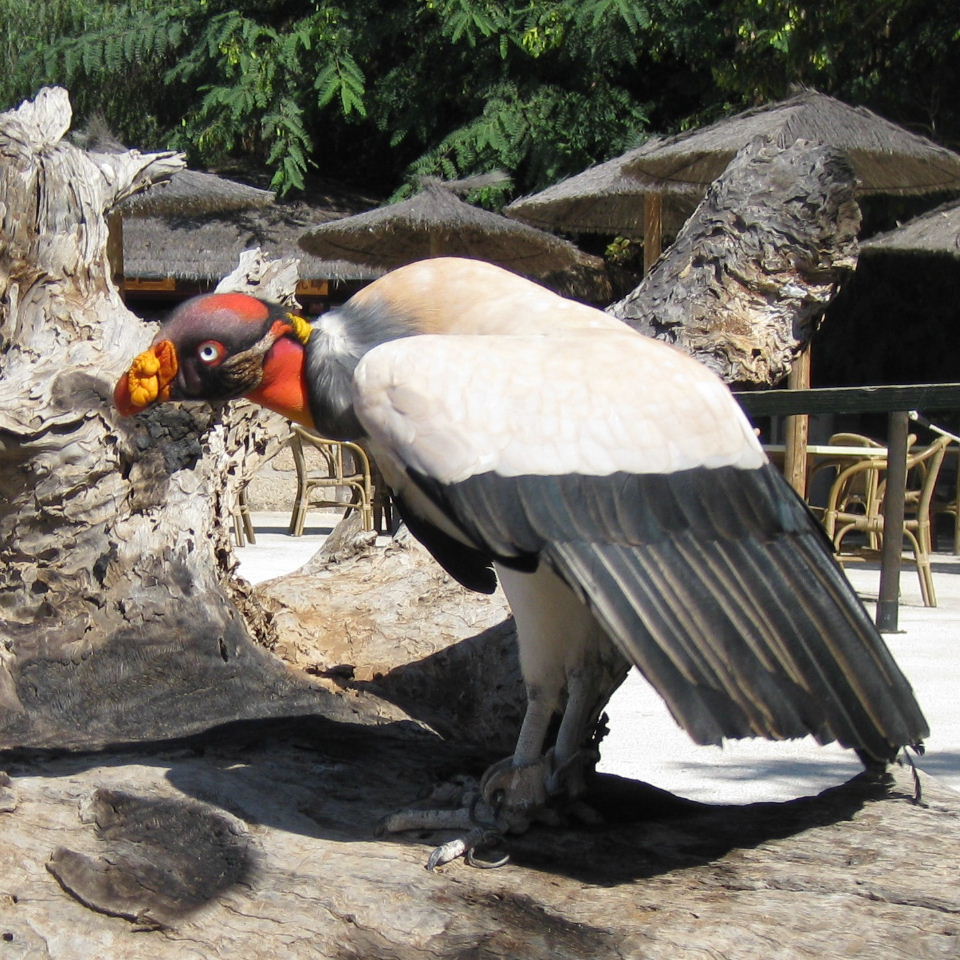
Beauty Of Animal | King Vulture | The King Vulture (Sarcoramphus papa) is a large bird found in Central and South America. It is a member of the New World vulture family Cathartidae. This vulture lives predominantly in tropical lowland forests stretching from southern Mexico to northern Argentina. Large and predominantly white, the King Vulture has gray to black ruff, flight, and tail feathers. The King Vulture has a very noticeable yellow fleshy caruncle on its beak. It also displaces smaller New World vulture species from a carcass. King Vultures have been known to live for up to 30 years in captivity.
King Vultures were popular figures in the Mayan codices as well as in local folklore and medicine. The species name is derived from Latin word papa "bishop", alluding the bird's plumage resembling the clothing of one. The King Vulture's closest living relative is the Andean Condor, Vultur gryphus. There are two theories on how the King Vulture earned the "King" part of its common name.
The exact systematic placement of the King Vulture and the remaining six species of New World vultures remains unclear.Though both are similar in appearance and have similar ecological roles, the New World and Old World vultures evolved from different ancestors in different parts of the world.. Like other New World vultures, the King Vulture has a diploid chromosome number of 80.
The genus Sarcoramphus, which today contains only the King Vulture, had a wider distribution in the past. The Kern Vulture (Sarcoramphus kernense), lived in southwestern North America during the mid-Pliocene (Piacenzian), some 3.5–2.5 million years ago) The fossil record, though scant, supports the theory that the ancestral King Vultures and South American Condors separated at least some 5 mya.
Excluding the two species of condors, the King Vulture is the largest of the New World vultures. Its overall length ranges from 67–81 centimeters (27–32 in) and its wingspan is 1.2–2 meters (4–6.6 ft). Its weight ranges from 2.7–4.5 kilograms (6–10 lb). An imposing bird, the adult King Vulture has predominantly white plumage, which has a slight rose-yellow tinge to it.The King Vulture has the largest skull and braincase, and strongest bill of the New World vultures. Unlike some New World vultures, the King Vulture lacks eyelashes.
The vulture is minimally sexually dimorphic, with no difference in plumage and little in size between males and females. The juvenile vulture has a dark bill and eyes, and a downy, gray neck that soon begins to turn the orange of an adult. Dark-plumaged immature birds may be confused with Turkey Vultures, but soar with flat wings, while the pale plumaged adults could feasibly be confused with the Wood Stork,although the latter's long neck and legs allow for easy recognition from afar.
The King Vulture soars for hours effortlessly, only flapping its wings infrequently.While in flight, its wings are held flat with slightly raised tips, and from a distance the vulture can appear to be headless while in flight. . It is non-migratory and, unlike the Turkey, Lesser Yellow-headed and American Black Vulture, it generally lives alone or in small family groups. King Vultures have lived up to 30 years in captivity, though their lifespan in the wild is unknown.
 
This vulture uses urohidrosis, defecating on its legs, to lower its body temperature. An adult King Vulture sexually matures when it is about four or five years old, with females maturing slightly earlier than males.The birds mainly breed during the dry season. King Vultures mate for life and generally lay a single unmarked white egg in its nest in a hollow in a tree.To ward off potential predators, the vultures keep their nests foul-smelling. 

Find Here The Kinds Of Animals and Flora and Fauna
Animal Flora and Fauna
READ MORE - King Vulture

Tuesday, June 5, 2012

Fruit Doves


Beauty Of Animal | Fruit Doves | Fruit doves are sex (Ptilinopus) in the bathroom and dove family (Columbidae). Found this colorful, Thamer doves in the forests and jungles of Southeast Asia and Oceania. It is a genus wide with about 50 species, and some already threatened or extinct.These small and medium-sized dove is generally a short, fan-shaped tails, and are remarkable for feathers stained and polished them in many cases, as seen in the aptly named Orange Dove Fruit, Fruit Dove Flame-Sadr, headed by Dov, pink fruit. Males and females of many species of fruit pigeons look very different. For example, many of the women dove fruit colored stock crown male crimson and deep feathers undertail pink and green, but otherwise, while the male has a crimson on the upper back, and areas of yellow, olive, cinnamon, and grey.This is a genus wide , and the most diverse in all parts of the island of New Guinea, the Philippines, and the geographical area of ​​biological Wallacea.


Some species may range as far west as the Sunda Islands, and some of the other north to Taiwan and southern Australia, and east in Polynesia.Fruit doves, as the name implies, eat fruit - Ficus is particularly important - and live in different types of forests, or forests. Some species are restricted to primary forests, such as rain forests and low-mountain forests, or monsoon forests, while others prefer secondary forest or in the troubled areas. Some species specialize in certain habitats, from coastal plains to forest cloud forest or moss forest of high altitude. There are only certain types of fruit doves in habitats dominated by certain plants, such as mangroves, eucalyptus, or pandanus.


And can usually only a few species to be considered in all parts of human habitation, and includes a handle fruit dove's beak, and Dov Makatea fruit, black naped fruit dove, which is known to visit gardens, such as.There is still much to be learned about fruit doves. Many types are shy and difficult to control in their natural environment. For example, there are many species in the Philippines, and for the most part, did not know little or nothing from their breeding or nesting behavior.

 
 Scientific classification
Kingdom:     Animalia
Phylum:     Chordata
Class:     Aves
Order:     Columbiformes
Family:     Columbidae
Genus:     Ptilinopus

Find Here The Kinds Of Animals and Flora and Fauna
Animal Flora and Fauna
READ MORE - Fruit Doves

Tuesday, February 7, 2012

Atlantic Puffin

Beauty Of Animal | Atlantic Puffin | The puffins (Fratercula arctica) is a seabird species in the auk family. Further known as the common puffin, it is the only species that puffins in the Atlantic to find "is. The Puffin is the provincial bird of the Canadian province of Newfoundland and Labrador. The puffin is 26-29 centimeters (10-11 in) in length (Bill 3-4 cm), with between 47 and 63 centimeters (19 to 25 in) wingspan. This bird is mostly black above and white below grow, with gray to white cheeks and red-orange legs. The characteristic bright orange bill plates before the breeding season and are shed after breeding. Bills in mating rituals, as the pair tapping their bills together.
 
The Horned Puffin related (Fratercula corniculata) from the North Pacific looks very similar, but slightly different headdress. The Puffin is typically silent at sea, except for soft purring sounds it sometimes makes in flight. This species breeds on the coasts of northern Europe, the Faroe Islands, Iceland and eastern North America, from and within the Arctic Circle to northern France and Maine. About 95% of puffins breed in North America around Newfoundland's coastlines.  
The largest puffin colony in the western Atlantic (estimated at more than 260,000 pairs) can be found at the Witless Bay Ecological Reserve, south of St. John's, Newfoundland and Labrador. Puffin viewing has also begun to become popular in Elliston Newfoundland, previously named Iceland Bird Cove, near Trinity.
Predators of puffins are the Great Black-backed Gull (Larus marinus), the Great Skua (Stercorarius skua), and similarly large species that can catch a puffin in flight, or choose a separated from the colony. More recent population decline may have been used because of increased predation by gulls and skuas, the introduction of rats, cats, dogs and foxes on some islands for nesting, contamination by toxic residues that have drowned in fishing nets, declining food supply, and climate change.
In the breeding season of 2006 about 68,000 pairs were counted on the Isle of May. However, Iceland has many times as many breeding pairs of puffins (Lundi in Icelandic) is the most populous bird on the island. In 2008, the decline in the Farne Islands and the Isle of May colonies reported. Because the puffin gets the bulk of their food by diving, it is important that there is an ample supply of resources and food. This study implies consequences for the species if global warming leads to a change in the tides.  
 
SOS Puffin is a project for the preservation of the Scottish Seabird Centre in North Berwick base to save the puffins on the islands in the Firth of Forth. Puffin numbers on the island of Craigleith, once one of the larest colonies in Scotland with 28,000 couples have only a few thousand over the invasion of a giant alien plant Tree Mallow, Lavatera arborea, which has taken over the island and crashed prevented the puffin access to their caves and breeding.
 
Find Here The Kinds Of Animals and Flora and Fauna
READ MORE - Atlantic Puffin

Thursday, December 8, 2011

Emperor Penguin

Beauty Of Animal | Emperor Penguin | Emperor penguins are the largest of all the average bird stands some 45 inches (115 centimeters) tall. The Emperor (Aptenodytes forsteri) is the tallest and heaviest of all living penguin species and is endemic to the Antarctic. The only penguin species that breeds during the Antarctic winter, it treks can 50-120 km (31-75 miles) above the ice to breeding colonies of thousands of individuals.Together with the similarly colored, but smaller King Penguin (A. patagonicus) The Emperor Penguin is one of two extant species in the genus Aptenodytes.
The adult Emperor penguin stands up to 122 cm (48 inches) tall. The weight ranges from 22.7 to 45.4 kg (50-100 lb) and varies depending on gender, with males weighing more than women. The weight varies depending on the season, as male and female penguins lose substantial mass while raising hatchlings and incubating eggs. To resist a male emperor penguin must protect the Antarctic cold for more than two months, its eggs from extreme cold. During this time he does not eat anything. Most male penguins around 12 kg (26 lb), whilst they wait for their babies to hatch.
 
The black plumage is sharply delineated by the bright plumage elsewhere. The Emperor Penguin Chick is usually with silver-gray below, and covered with a black head and white mask. The emperor penguin is dark brown plumage disappears until November to February, before the annual molt in January and February. Moulting is rapid in this species compared to other birds, with only about 34 days. Emperor Penguin feathers emerge from the skin after they have grown a third of their total length, and will be lost before old feathers to reduce heat losses.
Scientific classification
Kingdom:     Animalia
Phylum:     Chordata
Class:         Aves
Order:         Sphenisciformes
Family:     Spheniscidae
Genus:         Aptenodytes
Species:     A. forsteri
The average annual survival of emperor penguins has been measured at 95.1%, with an average life expectancy of 19.9 years. The same researchers estimated that 1% of emperor penguins hatched achieve a realistic age of 50 years.
The emperor penguin breeds in the coldest area of ​​bird species, air temperatures can reach -40 ° C (-40 ° F) and wind speeds can reach 144 km / h (89 mph). The water temperature is a frigid -1.8 ° C (28.8 ° F), which is significantly lower than the average body of the emperor penguin, the temperature of 39 ° C (102 ° F). . With around 100 feathers covering one square inch (15 feathers per cm2), it has the highest density of spring birds.
The Emperor Penguin is able to thermoregulate (maintain its body temperature), without the metabolism over a wide temperature range. At temperatures above 20 ° C (68 ° F), an emperor penguin can be excited as his body temperature and metabolic rate increases to increase the heat loss. Raising his wings and exposing the bottom increases the load on the body surface to the air by 16%, facilitating further heat loss. The emperor penguin is "least concern" as a type listed by the IUCN. Together with nine other species of penguins, it is currently under consideration for inclusion under the U.S. Endangered Species Act.
Through the application of mathematical models to predict how it would affect the loss of sea ice from global warming, a large colony of emperor penguins at Terre Adelie, Antarctica, they predicted a decline of 87% in the colony's population by the end of the century from the current 3000 breeding pairs in the colony of 400 breeding pairs. The decrease can throughout the Emperor Penguin population are mirrored, estimated at about 200,000 breeding pairs.

Find Here The Kinds Of Animals and Flora and Fauna
READ MORE - Emperor Penguin

Thursday, November 24, 2011

Rhinoceros Beetle

Beauty Of Animal | Rhinoceros Beetle |  The rhinoceros beetles or rhino beetle are a subfamily (Dynastinae) family of scarab (Scarabaeidae). Other common names - some for specific groups of rhino beetles - are, for example, Hercules beetle, beetles or unicorn horn beetle. There are over 300 known species of rhinoceros beetles.
Many rhinoceros beetles are known for their bizarre shapes and sizes. Famous types are, for example, the Atlas Beetle (Chalcosoma atlas), Common Rhinoceros Beetle (Xylotrupes ulysses), Elephant Beetle (Megasoma elephas), the European rhinoceros beetle (Oryctes nasicornis), Hercules Beetle (Dynastes hercules), Japanese rhinoceros beetle or kabutomushi (Allomyrina dichotoma) , Ox Beetle (Strategus Aloeus) and the Unicorn Beetle (Dynastes Tityus).

Description and ecology
They are among the largest beetles and reached 150 + mm in length, but are completely harmless to people, because they do not bite or sting. Their common name refers to the characteristic horns only by the males of most species carried in the group. They have a horn on his chest and another horn to the front of the center chest. The horns are used to fight other males during the mating season and for digging.
The body of an adult rhinoceros beetle is covered with a thick exoskeleton. A pair of thick wing was on a different set of wings including skin, so that the flying rhinoceros beetle, though not very efficient, due to their large size and horns. The best protection they have from predators is their size and stature. Furthermore, since they are nocturnal, they avoid many of their enemies during the day. When the sun shines, they hide under logs or vegetation is to be of the few large predators enough to want to hide to eat them. If rhinoceros beetles are disturbed, can release some squeaks very loud hiss. The hissing squeak is covering by rubbing its abdomen against the ends of their wings. Rhino beetles are pretty well protected, and the adults usually live 2-4 months, sometimes longer.
Can a rhinoceros beetle larval stage for several years and is very time consuming. Feed the larvae feed on rotten wood and the adults on nectar, plant sap and fruit. First, the larvae hatch from the eggs and later to develop into pupae before adult status (see picture left) to reach. The female lays 50 eggs on average. Contrary to what its size may mean eating adult rhinoceros beetle is not large amounts, in contrast to their larvae, which eat a significant amount of deadwood.
The human use
Rhino beetles are very popular as pets in parts of Asia.  This is partly due to the bare to maintain clean, easy and safe to handle. In Asia, male beetles are used for gambling fights.  Since men naturally tend to have to fight each other for the attention of the females, they are used to fight it. To get the two male beetles to fight Lock, a female beetle or a small noisemaker is used to duplicate the female lure.
Entomologist Séverin Tchibozo suggests the larvae contain lots of protein (40%), as a chicken (20%) and beef (18%) and larvae that had a protein source for a large  population. Are Some species can be important pests such as tree plantations. In general, however, are rhinoceros beetle population density is not as high as in some other insect pests, and food trees, which are usually already sick or die, other causes are preferred. Some species' larvae, but even attack healthy trees or root vegetables, and when they occur in large numbers to cause significant economic damage.

Find Here The Kinds Of Animals and Flora and Fauna
READ MORE - Rhinoceros Beetle