Search More Animals

Custom Search
Showing posts with label Snakes. Show all posts

Saturday, November 5, 2011

Oegon Gartersnake

Beauty Of Animals | Oregon Gartersnake |  Destruction of wetland habitat has been so widespread that this species is listed as threatened by the state and federal governments. The giant garter snake populations of the San Joaquin Valley are now tiny disconnected remnants. It has been extirpated from 98% of the former San Joaquin habitat. The giant garter snake has fared better in the Sacramento Valley because rice cultivation and the associated canals have provided habitat, when rice land is fallowed, populations seem to then move away from adjacent ditches.
In addition to habitat loss and fragmentation, introduced predators like the Bullfrog may also be suppressing recovery. Attempts are underway to restore artificial wetlands to provide quality habitat for the giant garter snake, but it is too early to know if these efforts will significantly aid the recovery of this threatened species.
Find Here The Kinds Of Animals and Flora and Fauna
READ MORE - Oegon Gartersnake

Thursday, September 8, 2011

Milksnake

Beauty Of Animal | Milksnake, Honduran | The Honduran milk snake (Lampropeltis triangulum hondurensis) is an egg laying species of non-venomous colubrid snake. It is one of the more commonly bred milk snakes in captivity and is one of the larger milksnakes reaching a length of 5 feet.The generic name (Lampropeltis) is derived from the Ancient Greek lamprós  meaning "bright" and peltas  meaning "shield", after the sheen of their scales. Its specific name (triangulum) is Latin for "triangle" and refers to the three colors found on the scales of the species (red, black, and yellow).

Its subspecific name hondurensis is a Latinization of their primary country of origin: Honduras.The Honduran milk snake's base color is red with distinct rings or bands of black and yellow. In some cases the yellow is actually a deep orange color and the animal in question is referred to as a tangerine phase. The Honduran milk snake is one of the larger subspecies of milk snake, attaining a length of 48 inches in the wild and some captive specimens reaching a length of 5 feet. The Honduran milk snake has a resemblance to the coral snake and this similarity in color, known as Batesian mimicry, helps protect the snake from potential predators.The Honduran milk snake inhabits low to medium elevations of the tropical areas of Honduras, Nicaragua, and Northeastern Costa Rica.
 
The Honduran milk snake uses constriction to kill its prey and tends to be opportunistic when it comes to its diet; they eat other snakes (ophiophagy), including venomous snakes, lizards, rodents, birds and eggs.Honduran milk snakes become sexually mature at 18 months. The females are oviparous,laying an average of 3-18 eggs per clutch in early June. The eggs incubate for approximately two months, and hatch in August or September. The hatchlings are 8 inches long and darker in color than their parents when they emerge from the eggs.Honduran milk snakes adapt well to captivity due to their relative ease of care and docile nature, and their large size and brilliant colors make them impressive and attractive pets. Like all king snakes and milk snakes, they must be housed alone, apart from the breeding season, because they are cannibalistic.


Find Here The Kinds Of Animals and Flora and Fauna
READ MORE - Milksnake

Friday, August 12, 2011

Boa Constricto


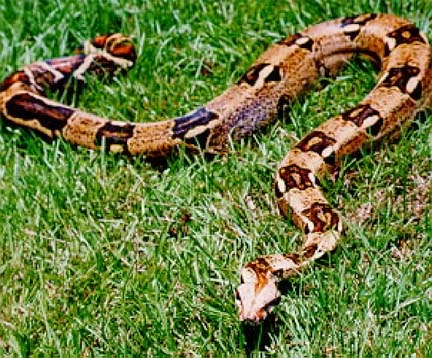
Beauty Of Animal | Boa Constricto | The Boa constrictor (Boa constrictor) is a large, heavy-bodied species of snake. It is a member of the family Boidae found in North, Central, and South America, as well as some islands in the Caribbean. A staple of private collections and public displays, its color pattern is highly variable yet distinctive. Ten subspecies are currently recognized, although some of these are controversial. This article focuses on the species Boa constrictor as a whole, but also specifically on the nominate subspecies Boa constrictor constrictor.Though all boids are constrictors, only this species is properly referred to as "Boa constrictor"; an almost unique instance of an animal having the same common and scientific binomial name. (The distinction is shared with Tyrannosaurus rex.)All subspecies are referred to as "Boa constrictors", while the nominate subspecies, B. c. constrictor, is often referred to specifically as the "red-tailed boa".


Within the exotic pet trade it is also known as a "BCC", an abbreviation of its scientific name, to distinguish it from other Boa constrictor subspecies such as the Boa constrictor imperator which is also regularly, and erroneously, referred to as a "red-tailed boa".Other common names include "jibóia" (Latin American) and "macajuel" (Trinidadian, pronounced mah-cah-well).The Boa constrictor is a large snake, although only modestly sized in comparison to other large snakes such as the reticulated and Burmese python, and can reach lengths of anywhere from 1–4 meters (3–13 feet) depending on the locality and the availability of suitable prey. There is clear sexual dimorphism seen in the species, with females generally being significantly larger in both length and girth than males. As such, the average size of a mature female boa is between 7–10 ft, whilst it is only 6–8 ft for the males. It is common for female individuals to exceed 10 ft, particularly in captivity, where lengths of up to 12 ft or even 14 ft can be seen.


A report of a Boa constrictor growing up to 18½ ft (5.5 m) was later found to be a misidentified green anaconda.[The Boa constrictor is a heavy-bodied snake, and large specimens can weigh up to 27 kg (60Ibs).The size and weight of a Boa constrictor depends on subspecies, locale and the availability of suitable prey. Several populations of Boa constrictors are known as "dwarf boas", such as the population of B. c. imperator on Hog Island. These smaller subspecies are generally insular populations. B. c. constrictor itself reaches, and occasionally tops, the averages given above, as it is one of the relatively large subspecies of Boa constrictor.Other examples of sexual dimorphism in the species include the fact that males generally have longer tails to contain the hemipenes and also longer pelvic spurs, which are used to grip and stimulate the female during copulation.Pelvic spurs are the only external sign of the rudimentary hind legs and pelvis, seen in all boas and pythons.


Find Here The Kinds Of Animals and Flora and Fauna
READ MORE - Boa Constricto

Sunday, August 7, 2011

Milksnake


Beauty Of Animal | Milksnake |The Honduran milk snake (Lampropeltis triangulum hondurensis) is an egg laying species of non-venomous colubrid snake. It is one of the more commonly bred milk snakes in captivity and is one of the larger milksnakes reaching a length of 5 feet.The generic name (Lampropeltis) is derived from the Ancient Greek lamprós  meaning "bright" and peltas  meaning "shield", after the sheen of their scales. Its specific name (triangulum) is Latin for "triangle" and refers to the three colors found on the scales of the species (red, black, and yellow).


Its subspecific name hondurensis is a Latinization of their primary country of origin: Honduras.The Honduran milk snake's base color is red with distinct rings or bands of black and yellow. In some cases the yellow is actually a deep orange color and the animal in question is referred to as a tangerine phase. The Honduran milk snake is one of the larger subspecies of milk snake, attaining a length of 48 inches in the wild and some captive specimens reaching a length of 5 feet. The Honduran milk snake has a resemblance to the coral snake and this similarity in color, known as Batesian mimicry, helps protect the snake from potential predators.The Honduran milk snake inhabits low to medium elevations of the tropical areas of Honduras, Nicaragua, and Northeastern Costa Rica.


The Honduran milk snake uses constriction to kill its prey and tends to be opportunistic when it comes to its diet; they eat other snakes (ophiophagy), including venomous snakes, lizards, rodents, birds and eggs.Honduran milk snakes become sexually mature at 18 months. The females are oviparous,laying an average of 3-18 eggs per clutch in early June. The eggs incubate for approximately two months, and hatch in August or September. The hatchlings are 8 inches long and darker in color than their parents when they emerge from the eggs.Honduran milk snakes adapt well to captivity due to their relative ease of care and docile nature, and their large size and brilliant colors make them impressive and attractive pets. Like all king snakes and milk snakes, they must be housed alone, apart from the breeding season, because they are cannibalistic.


Find Here The Kinds Of Animals and Flora and Fauna
READ MORE - Milksnake

Saturday, June 25, 2011

The Beauty Boa Constrictor

Beauty Of Animal | The Beauty Boa Constrictor | For other uses, see Boa constrictor (disambiguation) The Boa constrictor (Boa constrictor) is a large, heavy-bodied species of snake. It is a member of the family Boidae found in North, Central, and South America, as well as some islands in the Caribbean. A staple of private collections and public displays, its color pattern is highly variable yet distinctive. Ten subspecies are currently recognized, although some of these are controversial. This article focuses on the species Boa constrictor as a whole, but also specifically on the nominate subspecies Boa constrictor constrictor.
Though all boids are constrictors, only this species is properly referred to as "Boa constrictor"; an almost unique instance of an animal having the same common and scientific binomial name. (The distinction is shared with Tyrannosaurus rex.) All subspecies are referred to as "Boa constrictors", while the nominate subspecies, B. c. constrictor, is often referred to specifically as the "red-tailed boa". Within the exotic pet trade it is also known as a "BCC", an abbreviation of its scientific name, to distinguish it from other Boa constrictor subspecies such as the Boa constrictor imperator which is also regularly, and erroneously, referred to as a "red-tailed boa".
The Boa constrictor is a large snake, although only modestly sized in comparison to other large snakes such as the reticulated and Burmese python, and can reach lengths of anywhere from 1–4 meters (3–13 feet) depending on the locality and the availability of suitable prey. There is clear sexual dimorphism seen in the species, with females generally being significantly larger in both length and girth than males. As such, the average size of a mature female boa is between 7–10 ft, whilst it is only 6–8 ft for the males. It is common for female individuals to exceed 10 ft, particularly in captivity, where lengths of up to 12 ft or even 14 ft can be seen. A report of a Boa constrictor growing up to 18½ ft (5.5m) was later found to be a misidentified green anaconda.

The Boa constrictor is a heavy-bodied snake, and large specimens can weigh up to 27 kg (60Ibs).The size and weight of a Boa constrictor depends on subspecies, locale and the availability of suitable prey. Several populations of Boa constrictors are known as "dwarf boas", such as the population of B. c. imperator on Hog Island. These smaller subspecies are generally insular populations. B. c. constrictor itself reaches, and occasionally tops, the averages given above, as it is one of the relatively large subspecies of Boa constrictor.
Other examples of sexual dimorphism in the species include the fact that males generally have longer tails to contain the hemipenes and also longer pelvic spurs, which are used to grip and stimulate the female during copulation. Pelvic spurs are the only external sign of the rudimentary hind legs and pelvis, seen in all boas and pythons.

The coloring of Boa constrictors can vary greatly depending on the locality. However, they are generally a brown, grey or cream base color, patterned with brown or reddish brown "saddles" that become more pronounced towards the tail. It is this coloring that gives Boa constrictor constrictor the common name of "red-tailed boa", as it typically has more red saddles than other boa constrictor subspecies. The coloring works as very effective camouflage in the jungles and forests of its natural range.

There are also individuals that exhibit pigmentary disorders such as albinism. Although these individuals are rare in the wild, they are common in captivity where they are often selectively bred to make a variety of different color "morphs". Boa constrictors have an arrow-shaped head that has very distinctive stripes on it. One runs dorsally from the snout to the back of the head. The others run from the snout to the eyes and then from the eyes to the jaw.

Boa constrictors can sense heat via cells in their lips, though they lack the labial pits surrounding these receptors seen in many members of the boidae family. Boa constrictors also have two lungs, a smaller (non-functional) left and enlarged (functional) right lung to better fit their elongated shape, unlike many colubrid snakes which have completely lost the left lung.

Find Here The Kinds Of Animals and Flora and Fauna
READ MORE - The Beauty Boa Constrictor

The Beauty Brazilian Rainbow

Beauty Of Animal | The Beauty Brazilian Rainbow | Epicrates cenchria is a boa species found in Central and South America. Common names include the rainbow boa, and slender boa. A terrestrial species, it is known for its attractive iridescent sheen. Nine subspecies are currently recognized, including the nominate subspecies described hereFound in lower Central America in Costa Rica and Panama. In South America it occurs east of the Andes in Colombia, Venezuela, Trinidad and Tobago, Guyana, Suriname, French Guiana, Brazil, Ecuador, Peru, Bolivia, Paraguay and northern Argentina (in the provinces of Chaco, Córdoba, Corrientes, Formosa, Salta, Santiago del Estero and Tucumán). The type locality given is "Surinami.

Despite requiring very specific humidity and heat, this species is commonly found in the pet trade. During the 1980s and early 1990s, substantial numbers were exported from Suriname. Today, however, far fewer are exported and most offered for sale are captive bred. Due to their requirements of high humidity in a captive environment, they should be considered intermediate for snake owners, but once these have been met they generally thrive in captivity. Younger specimens will often bite, but tend to calm down as they become more used to handling.

Find Here The Kinds Of Animals and Flora and Fauna
READ MORE - The Beauty Brazilian Rainbow

Wednesday, June 22, 2011

The Beauty Of The Glossy Snake

 Beauty Of Animlas | The Beauty Of The Glossy Snake |Arizona elegans is a medium-sized colubrid snake commonly referred to as the glossy snake. The genus Arizona has only one officially recognized species, A. elegans, with several subspecies. Some have recommended that A. elegans occidentalis be granted full species status.

The glossy snake and its many subspecies are all similar in appearance to gopher snakes. However, they are smaller than gopher snakes, with narrow, pointed heads, and a variety of skin patterns and colors. They are nonvenomous, nocturnal predators of small mammals and lizards. Most subspecies are ca. 75-130 cm (ca. 30-50 inches) in length and are shades of tan, brown, and gray with spotted patterns on their smooth, glossy skin and a white or cream-colored unmarked ventral surface. Coloration often varies in relation to the color of the soil in a snake's native habitat.

Glossy snakes are oviparous. They breed in the late spring and early summer and young hatch out in the early fall. Clutches average from 10 to 20 young that are approximately 25 cm long.

Find Here The Kinds Of Animals and Flora and Fauna
READ MORE - The Beauty Of The Glossy Snake

The Beauty Of The Southern Copperhead

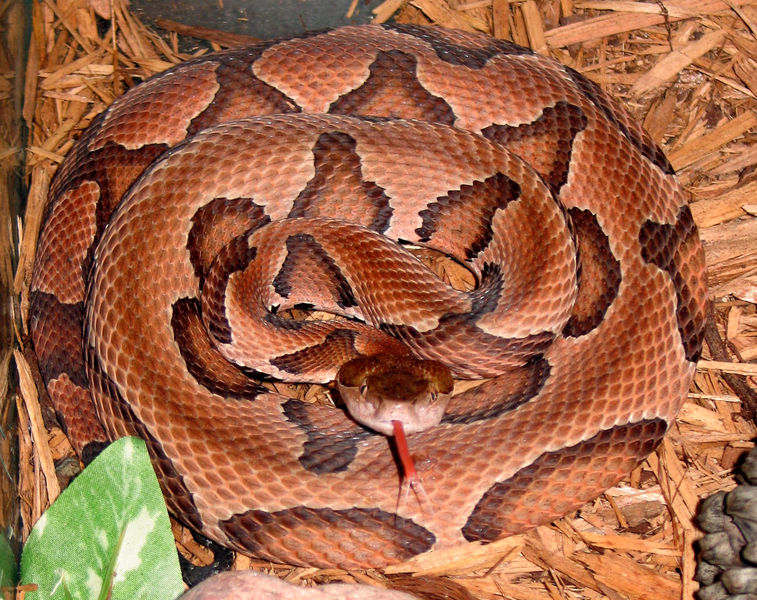
Beauty Of Animlas | The Beauty Of The Southern Copperhead | Agkistrodon contortrix is a species of venomous snake found in North America, a member of the Crotalinae (pit viper) subfamily. Common names for the species include Copperhead and moccasin. The behavior of Agkistrodon contortrix may lead to accidental encounters with humans. Five subspecies are currently recognized, including the nominate subspecies described here.

Adults usually grow to a total length of 50–95 cm (20–37 in), although some may exceed 1 m (3.3 ft). Males are usually larger than females. The maximum length reported for this species is 134.6 cm (53.0 in) for A. c. mokasen (Ditmars, 1931). Brimley (1944) mentions a specimen of A. c. mokasen from Chapel Hill, North Carolina, that was "four feet, six inches" (137.2 cm), but this may have been an approximation. The maximum length for A. c. contortrix is 132.1 cm (52.0 in) (Conant, 1958).

The body is relatively stout and the head is broad and distinct from the neck. Because the snout slopes down and back, it appears less blunt than that of the cottonmouth, A. piscivorus. Consequently, the top of the head extends further forward than the mouth.

The scalation includes 21-25 (usually 23) rows of dorsal scales at midbody, 138-157 ventral scales in both sexes and 38-62/37-57 subcaudal scales in males/females. The subcaudals are usually single, but the percentage thereof decreases clinally from the northeast, where about 80% are undivided, to the southwest of the geographic range where as little as 50% may be undivided. On the head there are usually 9 large symmetrical plates, 6-10 (usually 8) supralabial scales and 8-13 (usually 10) sublabial scales.

The color pattern consists of a pale tan to pinkish tan ground color that becomes darker towards the midline, overlaid with a series of 10-18 (13.4) crossbands. Characteristically, both the ground color and crossband pattern are pale in A. c. contortrix. These crossbands are light tan to pinkish tan to pale brown in the center, but darker towards the edges. They are about 2 scales wide or less at the midline of the back, but expand to a width of 6-10 scales on the sides of the body. They do not extend down to the ventral scales. Often, the crossbands are divided at the midline and alternate on either side of the body, with some individuals even having more half bands than complete ones. A series of dark brown spots is also present on the flanks, next to the belly, and are largest and darkest in the spaces between the crossbands. The belly is the same color as the ground color, but may be a little whitish in part. At the base of the tail there are 1-3 (usually 2) brown crossbands followed by a gray area. In juveniles, the pattern on the tail is more distinct: 7-9 crossbands are visible, while the tip is yellow. On the head, the crown is usually unmarked, except for a pair of small dark spots, one near the midline of each parietal scale. A faint postocular stripe is also present; diffuse above and bordered below by a narrow brown edge.

Several aberrant color patterns for A. c. contortrix, or populations that intergrade with it, have also been reported. In a specimen described by Livezey (1949) from Walker County, Texas, 11 of 17 crossbands were not joined middorsally, while on one side three of the crossbands were fused together longitudinally to form a continuous undulating band, surmounted above by a dark stripe that was 2-2.5 scales wide. In another specimen, from Lowndes County, Alabama, the first three crossbands were complete, followed by a dark stripe that ran down either side of the body, with points of pigment reaching up to the midline in six places but never getting there, after which the last four crossbands on the tail were also complete. A specimen found in Terrebonne Parish, Louisiana by Ernest A. Liner, had a similar striped pattern, with only the first and last two crossbands being normal.

Find Here The Kinds Of Animals and Flora and Fauna
READ MORE - The Beauty Of The Southern Copperhead

Tuesday, May 24, 2011

King Cobra Snakes

 Beuty Of Animlas | King Cobra Snakes | The King Cobra Snake (Ophiophagus hannah) is the largest venomous snake in the world. The King Cobra snake is also perhaps the most dangerous snake in the world where humans are concerned. Under conditions of high prey availability they can reach a length of 18.5 feet. Several people die from the bite of the King Cobra each year. A King Cobra can even kill an elephant.

The King Cobra snake is the largest of the venomous land snakes, growing up to 18.5 feet (5.7 metres) in length and with a width of up to 1 foot (0.3 metres) at the neck. However, as they are generally slender, King Cobras usually do not exceed 44 pounds (20 kilograms) in weight. Male King Cobras are longer and weigh more than female King Cobras, this is very unusual since in most snake species, the male is smaller than the female. 
 
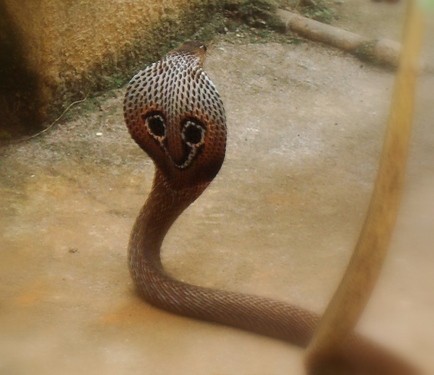
The King Cobra can lift a third of its body off the ground. In fact, an 18 foot King Cobra, if stood upright, could actually look down onto the average human being. Like other snakes bearing the cobra name, the King Cobra can also flatten its neck, giving it the distinctive hood. When the King Cobra is threatened or on the attack, it will hiss, rear up and flatten its neck ribs into the hood. There are false eyespots on the hood, which can scare some predators. Even though their scaly skin glistens, it is actually dry to the touch. Adults cobras are yellow, green, brown, or black. Their throat is light yellow or cream coloured. Juveniles are black with yellow or white bars crossing the body. 

King Cobra Snake Habitat

The King Cobra snake lives in much of mainland South East Asia and throughout the dense highland forests. The King Cobra has a preference for living in areas where there are lakes and streams as it is an excellent swimmer. King Cobra populations have reclined in some areas of its range due to the destruction of forests, however, despite this the snake is not listed by the IUCN as in danger of becoming extinct. The King Cobra is said to be the only snake which makes nests for its eggs. It is widely worshipped in India as nagaraja ('king of snakes').

King Cobra Snake Behaviour and Diet

A Group of King Cobras is called a 'Quiver'. Despite the King Cobras fearsome reputation, it is generally a shy and reclusive animal, avoiding confrontation with people as much as possible. There are many smaller venomous snakes within this species range that are responsible for a far greater number of fatal snake bites. The King Cobra snakes diet is mainly composed of other snakes (ophiophagy - a specialized form of feeding or alimentary behaviour of animals which hunt and eat snakes). The King Cobra snake prefers non-venomous snakes, however, it will also eat other venomous snakes including kraits and Indian Cobras.

Cannibalism is not rare. When food is scarce, King Cobras will also feed on other small vertebrates such as lizards. Like all snakes, they swallow the prey whole, head first. The top and bottom jaws are attached to each other with stretchy ligaments, which let the snake swallow animals wider that itself. Snakes cannot chew their prey. Food is digested by very strong acids in the snakes stomach. After a large meal the snake may live for many months without another meal due to a very slow metabolic rate. King Cobras are able to hunt at all times of day, although it is rarely seen at night, leading some to debate whether it is a diurnal species.
 
King Cobras, like other snakes, smell using their forked tongue which picks up scent particles and transfers them to a special sensory receptor (Jacobson's Organ), located in the roof of its mouth. When the scent of a potential meal has been detected, the snake will continue to flick its tongue to gauge the preys direction. It will also rely on its excellent eyesight. The King Cobra snake is able to detect moving prey almost 300 feet (100 metres) away. The King Cobra snake uses sensitivity to vibrations and outstanding intelligence (compared to that of other cobra species) to track its prey.

King Cobra Snake Reproduction

Breeding usually takes place in late spring or early summer. After mating, the male will return back to its own home. The female will then lay between 10 and 25 eggs. The offspring are independent as soon as they are born and can capture prey the size of a rat.
Breeding takes place when the two snakes twist their bodies together and can last for days in this position. Females wait approximately 55 days before laying eggs. Female offspring are not bigger than male offspring. The King Cobra snakes average life span is about 20 years.

King Cobra Snake Venom


The King Cobras venom is a neurotoxin, capable of killing humans. The mortality rate can be as high as 75%, however, most bites involve nonfatal amounts. Their venom is not the most potent among venomous snakes, however, the amount of neurotoxin they can deliver in a single bite - up to two-tenths of a fluid ounce (seven millilitres) - is enough to kill 20 people, or even an elephant. Fortunately, king cobras are shy and will avoid humans whenever possible. King Cobra snakes are fiercely aggressive when cornered or provoked.
 
King Cobra venom, which is composed mostly of proteins and polypeptides, is produced in specialized salivary glands just behind the snakes eyes. When biting its prey, venom is forced through the snakes half - inch - long (8 - 10 millimetre) fangs and into the wound. Although the venom is less toxic than that of many other venomous snakes, including the Indian Cobra, a King Cobra is capable of injecting more venom than any other snake except the gaboon viper. In fact, a King Cobra can deliver enough venom to kill a full-grown Asian Elephant in 3 hours.
 
King Cobra venom attacks the victims nervous system and quickly induces severe pain, blurred vision, vertigo, drowsiness and paralysis. In the minutes following, cardiovascular collapse occurs and the victim falls into a coma. Death soon follows due to respiratory failure.
READ MORE - King Cobra Snakes

The Beauty Of Anaconda Snake

Beuty Of Animlas | The Beauty Of Anaconda Snake | The Anaconda Snake is without doubt one of the most beautiful snakes in the world. Growing in some cases to greater than 26 feet (8 meters) it is also one of the longest and some might say the deadliest. Even though the Anaconda has the capability of devouring a man, in reality has little or no interest in hurting humans, mainly focusing on small reptiles and fish as its main food source. In fact, if an Anaconda were to come across a person in the Jungle it is most likely it would be snake doing the running (or slithering if you want to be more exact).
READ MORE - The Beauty Of Anaconda Snake

The Beuty of Python Sebae

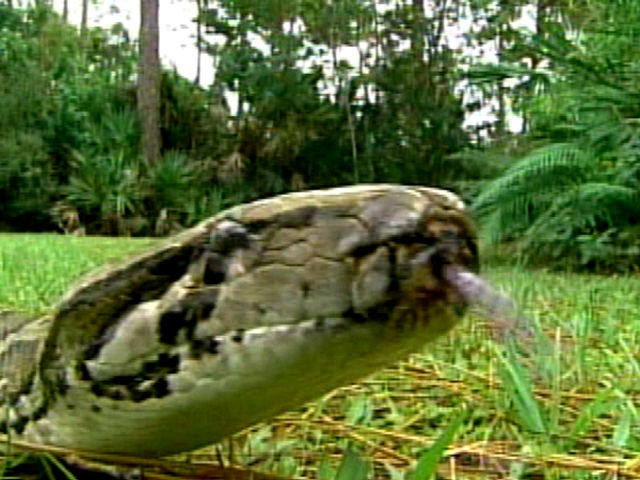
 Beuty Of Animlas | The Beuty of Python SebaePython sebae is a nonvenomous python species found in subsaharan Africa. This is one of the world's largest species of snakes. Two subspecies are currently recognized, including the nominate subspecies described here. Python sebae was first described by Johann Friedrich Gmelin in 1788. Its generic name Python is a Greek word referring to the enormous serpent at Delphi slain by Apollo in Greek Mythology. Its specific name sebae is a Latinized genitive form of Dutch zoologist, Albertus Seba's last name. This is one of the world's largest species of snakes with adults reaching lengths of over 6 m (20 ft). The typical adult length is 4.8 m (16 ft) and rumors of specimens over 6 m (20 ft) are generally considered reliable, but larger specimens have never been confirmed
READ MORE - The Beuty of Python Sebae