Search More Animals

Custom Search
Showing posts with label Fox. Show all posts

Monday, September 10, 2012

Arctic Wolf

Beauty Of Animal | Arctic Wolf | Arctic Wolf, The Arctic wolf is found in the most northern parts of the wolf 's range, in the Arctic Circle. Arctic wolves mainly inhabit Northern Canada and Alaska, parts of Greenland and Iceland and Northern Europe. Arctic wolves are incredibly versatile and adaptive animals, Able to withstand year round sub​​-zero Temperatures. Living in the Arctic Circle, the Arctic wolf spends five out of twelve months in total darkness.
The Arctic wolf hunts lemmings, assorted rodents, and Arctic hare but will take larger prey like caribou when available. When the Arctic wolf wants to hunt musk ox, the pack will gather and work as a team attempt to isolate it from the herd and take it. An adult musk ox is simply too big for one Arctic wolf to try and take on alone
Although the Arctic wolf is generally smaller in size than the gray wolf, Arctic wolves growing niche to be bulkier than gray wolves with the male Arctic wolves also growing larger than the female Arctic wolves.
Normally, only the alpha male and female Arctic wolf Arctic wolves breed, but if a pack gets too large it may break up into new smaller packs giving others the opportunity to mate. Due to the Arctic Circle's uncompromising permafrost soil and the difficulty it poses for digging dens, Arctic wolves Often use rock outcroppings, caves or even shallow depressions as dens instead.
Arctic wolf pups are born in litters of two or three in the months of May and June, meaning that the Arctic wolf pups are born about a month later than the gray wolf pups. Arctic wolves growing niche to be white with brown irises, unlike most other subspecies of wolves with yellow to amber eyes. White fur gives them camouflage in a snowy environment, and the darker irises give added protection to the eyes in a high glare environment.

Find Here The Kinds Of Animals and Flora and Fauna
READ MORE - Arctic Wolf

Thursday, June 23, 2011

The Beauty Of Fennec Fox

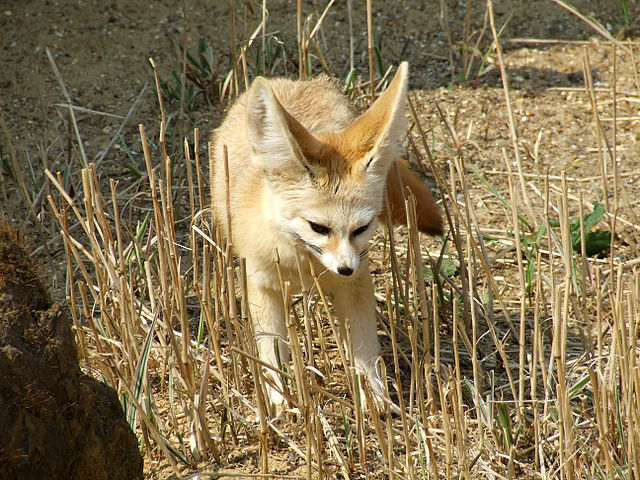
Beauty Of Animals | The Beauty Of The Fennec Fox | The Fennec Fox (Vulpes zerda) is a small nocturnal fox found in the Sahara of North Africa. Its most distinctive feature is unusually large ears. The name "Fennec" comes from the Arabic word for fox, and the species name zerda has a Greek origin that refers to its habitat. The Fennec is the smallest species of canid in the world; coat, ears and kidney functions have adapted to a high-temperature, low-water, desert environment. In addition, its hearing is sensitive enough to hear prey moving underground.
The Fennec has a life span of up to 10 years in the wild; its main predators include the Caracal and the African varieties of Eagle Owl. Families of Fennecs dig out dens in sand for habitation and protection, which can be as large as 120 m2 (1,292 sq ft) and adjoin the dens of other families. Precise population figures are not known but are estimated from the frequency of sightings; these indicate that the animal is currently not threatened by extinction. Knowledge of social interactions is limited to information gathered from captive animals. The species is usually assigned to the genus Vulpes; however, this is debated due to differences between the Fennec Fox and other fox species. The Fennec's fur is prized by the indigenous peoples of North Africa, and in some parts of the world, the animal is considered an exotic pet.
The Fennec Fox weighs about 1.5–3.5 lb (0.68–1.6 kg), with a body length of between 24–40 cm (9–16 in); it is around 20.3 cm (8 in) tall.[2] It is the smallest species of canid in the world. The tail has a black tip and is around three quarters of the length of the head and body, while the ears can be between 10–15 cm (3.9–5.9 in) long. Its name comes from the Arabic word fanak, which means fox, and the species name zerda comes from the Greek word xeros which means dry, referring to the fox's habitat.
The coat is often a cream color and fluffy, which deflects heat during the day and keeps the fox warm at night. The Fennec's characteristic ears are the largest among all foxes relative to body size, and serve to dissipate heat, as they have many blood vessels close to the skin. The ears of a Fennec are sensitive enough to hear prey that may be underground  the soles of its feet are protected from the hot desert sand by thick fur.

Social behaviour

"A greyscale sketch of a group of long eared foxes on a rocky outcrop in a desert. There is a crumbling brick building to the left and two of the foxes are on lookout." An 1876 sketch of a pack of Fennec Foxes Information on Fennec Fox social behaviour is mainly based on captive animals. The basic social unit is thought to be a mated pair and their offspring, and the young of the previous year are believed to remain in the family even after a new litter is born. Playing behaviour is common, including among adults of the species.
Captive animals engage in highly social behaviour, typically resting while in contact with each other. Males tend to show more aggression and urine-marking around the time of the females' estrous cycle. They have been seen to bury feces by pushing soil with their noses or hind feet when in captivity. Much remains unknown of their basic ecology and behavior in the wild, and a 2004 report by the International Union for Conservation of Nature stated that "in-depth study of the species, with particular emphasis on habitat use and population dynamics in the wild, is overdue."


 Diet and hunting
The Fennec Fox is a nocturnal omnivore. Food sources include rodents, insects, birds and eggs. An individual can jump up to 2 ft (61 cm) high and 4 ft (120 cm) forward, which helps it catch prey and escape predators. When hunting, large eared foxes such as the Fennec, or the Bat-eared Fox, can seem to stare at the ground while they rotate their heads from side to side to pinpoint the location of prey, either underground or hidden above ground. The species is able to live without free water, as its kidneys are adapted to restrict water loss. A Fennec's burrowing can cause the formation of dew. They are also known to absorb water through food consumption; but will drink water if available.

Find Here The Kinds Of Animals and Flora and Fauna
READ MORE - The Beauty Of Fennec Fox

Channel Island Fox-Urocyon Littoralis

Beauty Of Animals |  Channel Island Fox-Urocyon Littoralis | The island fox (Urocyon littoralis) is a small fox that is native to six of the eight Channel Islands of California. There are six subspecies of the fox, each unique to the island it lives on, reflecting its evolutionary history. Other names for the island fox include coast fox, short-tailed fox, island gray fox, Channel Islands fox, Channel Islands gray fox, California Channel Island fox and insular gray fox. At just 3 to 6 pounds, the island fox is the largest mammalian predator on the Channel Islands. These tiny foxes are true California Natives: they are found on six of the eight Channel Islands off the California Coast, and nowhere else in the world. STATUS: Between 1994 and 2000, island foxes declined by 85% across four of the islands. They are listed as Critically Endangered by the International Union for Conservation of Nature (IUCN).

HABITAT: The island foxes are found on six of the Channel Islands: San Clemente, San Miguel, Santa Rosa, Santa Cruz, Santa Catalina, and San Nicholas. The islands are semi-arid and receive less than six inches of rainfall per year. The foxes live in chaparral, coastal scrub, grassland, and woodland habitats.

DIET: Island foxes are omnivorous. They hunt deer mice, reptiles, birds, and insects one of their favorite foods is the Jerusalem cricket. They also take advantage of the native fruit and plants found on the islands and will eat crabs and sea mammals that wash ashore.

PHYSICAL CHARACTERISTICS: The island fox is the smallest fox in North America. About the size of a domestic cat, they are 23 to 27 inches long from nose to tail. Each of the six island populations form their own subspecies with specific physical and genetic differences. Male island foxes are a little larger than females, and they form monogamous pairs that usually mate for life.
Nature Out of Balance

The plight of the island fox illustrates the interconnectivity of all the elements of the environment, and how changing one element can put an entire ecosystem in jeopardy. When the bald eagle thrived on the Channel Islands, the eagles and foxes lived in balance, because bald eagles eat fish and other marine life, not foxes. In the 1960s, the bald eagle began dying off on the islands due to DDT pesticides that ended up in the ocean. The pesticides would enter the eagle’s system through the fish that it ate, causing the eagles to lay eggs with very thin shells that would not survive incubation.

When the bald eagles disappeared, another predator moved in to take their place: golden eagles. These eagles were initially attracted to the island by feral pigs, which had been introduced as domestic livestock in the 19th century. Unlike other foxes, the island fox had never had a predator and hunted during the day. In addition, other non-native domestic animals, such as sheep, goats, and cows, had reduced the tall, native grasses through grazing. All this resulted in making the foxes easy prey for the new eagle predators.

Between 1995 and 2000, the island foxes nearly went extinct on several islands. On San Miguel, the population dropped from 450 to 15 individuals. On Catalina, distemper from an unvaccinated domestic dog spread through the fox population and wiped out over 80% of the foxes on the eastern part of the island. Today, the fox population is recovering due to the combined efforts of multiple organizations. Efforts include relocating golden eagles, reintroducing bald eagles, removing feral pigs and alien plant species, reestablishing native plant species, and captive breeding for reintroduction purposes.

Find Here The Kinds Of Animals and Flora and Fauna
READ MORE - Channel Island Fox-Urocyon Littoralis

The Beauty Of The Bat-Eared Fox

Beauty Of Animal | The Beauty Of The Bat-Eared Fox  | There are a total of 23 different species of foxes in the world, but the bat-eared fox’s anatomy is so unique that it is the only animal in its genus, Otocyon.  This African native is best known for its conspicuously large ears and unique dental makeup. STATUS: The bat-eared fox is classified as lower risk, meaning that the population is fairly stable in the wild.

HABITAT: Interestingly, the bat-eared fox resides in two disconnected areas in eastern Africa, from southeast Sudan to the middle of Tanzania; and in southern Africa, from Angola to regions of South Africa.  These furry hunters prefer open, grassy plains and savannas with relatively little rainfall.

DIET: This fox is omnivorous, although their primary food is insects, which constitute up to 80% of their diet. Their favorites include dung beetles, locusts, and grasshoppers, and they will catch their prey with the traditional “pounce” or “jump” used by many other foxes. They are the only member of the canine family that prefers insects over any kind of meat. The bat-eared fox is also known to dine on fruit, vegetable matter, roots, ground-based birds, eggs, small mammals and reptiles, and other invertebrates such as scorpions.

PHYSICAL CHARACTERISTICS: The bat-eared fox’s most obvious features, of course, are its generously sized, 5-inch long ears, which provide acute hearing. This species relies primarily on its hearing to find food. They can even detect the underground movement of a termite or a beetle larvae!

These foxes are also distinguished by their unique teeth. Specifically, they have more of them than any other canine—between 46 and 50. Their canine teeth are strong and sharp, while the rear teeth are smaller and flatter, an adaptation that probably arose from munching on lots of chewy insects.

Their bodies are slender and compact, measuring only about 1½ to 2 feet long with a tail of around 9 to 13 inches. Both sexes weigh 6 to 12 pounds, and females are slightly larger. Their fur ranges from dust- to dirt-brown, with black fur around the feet, tail tip, and edges of the ears. They also usually have patches of white around the muzzle and eyes.
Deep in the Den

Mating has not been well-observed in the wild, but it is believed that bat-eared foxes are monogamous, and breed once a year. Pups are born during the rainy part of summer, when insects are most abundant. These nocturnal creatures live in nuclear family units and construct roomy underground dens with multiple entrances and chambers, preferably hidden by grassy or overgrown vegetation. The may move to a new den if the old one becomes unsafe—for example, if a predator discovers its location. There are a total of 23 different species of foxes in the world, but the bat-eared fox’s anatomy is so unique that it is the only animal in its genus, Otocyon.  This African native is best known for its conspicuously large ears and unique dental makeup. STATUS: The bat-eared fox is classified as lower risk, meaning that the population is fairly stable in the wild.

HABITAT: 
Interestingly, the bat-eared fox resides in two disconnected areas in eastern Africa, from southeast Sudan to the middle of Tanzania; and in southern Africa, from Angola to regions of South Africa.  These furry hunters prefer open, grassy plains and savannas with relatively little rainfall.

DIET: 
This fox is omnivorous, although their primary food is insects, which constitute up to 80% of their diet. Their favorites include dung beetles, locusts, and grasshoppers, and they will catch their prey with the traditional “pounce” or “jump” used by many other foxes. They are the only member of the canine family that prefers insects over any kind of meat. The bat-eared fox is also known to dine on fruit, vegetable matter, roots, ground-based birds, eggs, small mammals and reptiles, and other invertebrates such as scorpions.

PHYSICAL CHARACTERISTICS: 
The bat-eared fox’s most obvious features, of course, are its generously sized, 5-inch long ears, which provide acute hearing. This species relies primarily on its hearing to find food. They can even detect the underground movement of a termite or a beetle larvae!

These foxes are also distinguished by their unique teeth. Specifically, they have more of them than any other canine—between 46 and 50. Their canine teeth are strong and sharp, while the rear teeth are smaller and flatter, an adaptation that probably arose from munching on lots of chewy insects.

Their bodies are slender and compact, measuring only about 1½ to 2 feet long with a tail of around 9 to 13 inches. Both sexes weigh 6 to 12 pounds, and females are slightly larger. Their fur ranges from dust- to dirt-brown, with black fur around the feet, tail tip, and edges of the ears. They also usually have patches of white around the muzzle and eyes.
Deep in the Den

Mating has not been well-observed in the wild, but it is believed that bat-eared foxes are monogamous, and breed once a year. Pups are born during the rainy part of summer, when insects are most abundant. These nocturnal creatures live in nuclear family units and construct roomy underground dens with multiple entrances and chambers, preferably hidden by grassy or overgrown vegetation. The may move to a new den if the old one becomes unsafe—for example, if a predator discovers its location.

Find Here The Kinds Of Animals and Flora and Fauna
READ MORE - The Beauty Of The Bat-Eared Fox