Search More Animals

Custom Search

Sunday, July 31, 2011

Eagle-Golden


Beauty Of Animal | Eagle-Golden | The Golden Eagle (Aquila chrysaetos) is one of the best known birds of prey in the Northern Hemisphere. Like all eagles, it belongs to the family Accipitridae. Once widespread across the Holarctic, it has disappeared from many of the more heavily populated areas. Despite being extirpated from some its former range or uncommon, the species is still fairly ubiquitous, being present in Eurasia, North America, and parts of Africa. The highest density of nesting Golden Eagles in the world lies in southern Alameda County, California. These birds are dark brown, with lighter golden-brown plumage on their heads and necks.


Golden Eagles use their agility and speed combined with extremely powerful talons to snatch up prey including rabbits, marmots, ground squirrels, and large mammals such as foxes, wild and domestic cats, mountain goats, ibex, and young deer. They will also eat carrion if prey is scarce, as well as reptiles. Birds, including large species up to the size of swans and cranes as well as ravens and Greater Black-backed Gulls have all been recorded as prey. They have even been known to attack and kill fully grown roe deer. The Eurasian subspecies is used to hunt and kill wolves in many native communities, where their status is regarded with great mystic reverence.


Golden Eagles maintain territories that may be as large as 155 square kilometres (60 square miles). They are monogamous and may remain together for several years or possibly for life. Golden Eagles nest in high places including cliffs, trees, or human structures such as telephone poles. They build huge nests to which they may return for several breeding years. Females lay from one to four eggs, and both parents incubate them for 40 to 45 days. Typically, one or two young survive to fledge in about three months.

 
Find Here The Kinds Of Animals and Flora and Fauna
READ MORE - Eagle-Golden

Bat-Short-Tailed Fruit


Beauty Of Animal | Bat-Short-Tailed Fruit | Seba's Short-tailed Bat, Carollia perspicillata, is a common and widespread bat species from South and Central America.


C. perspicillata dwells in both moist evergreen and dry deciduous forests, usually below 1,000 meters altitude, typically roosting in groups of 10-100 bats in caves, hollow trees, tunnels, and road culverts. It feeds on a least 50 different species of fruit, as well as pollen and insects.


Find Here The Kinds Of Animals and Flora and Fauna
READ MORE - Bat-Short-Tailed Fruit

Bat-Common Vampire


Beauty Of Animal | Bat-Common Vampire | Vampire bats tend to live in colonies in almost completely dark places, such as caves, old wells, hollow trees, and buildings. They range in Central to South America and live in arid to humid, tropical and sub tropical areas. Vampire bats live in colonies that can number in the thousands in roosting sites. The basic social structure of roosting bats is made of harems which are composed of females and their offspring and a few adult males, known as "resident males" and a separate group of males, known as "non-resident males". In hairy legged vampire bats, the hierarchical segregation of non-resident males is less strict than in common vampire bats.Non-resident males are accepted into the harems when the ambient temperature lowers. This behavior suggests social thermoregulation.


Resident males mate with the females in their harems, however it is common for outside males to copulate with the females.Female offspring usually remain in their natal groups unless their mothers die or move. Several matrilines can be found in a group as unrelated females regularly join groups. Male offspring tend to live in their natal groups until they are about two years old, sometimes being forcefully expelled by the resident adult males.


Vampire bats are believed to be the only species of bats in the world to "adopt" another young bat if something happens to the bat's mother.Vampire bats also share a strong family bond with members of the colony, which is believed to be why they are the only bats to take up this adoption characteristic. Another unique adaptation of vampire bats is the sharing of food. A vampire bat can only survive about two days without a meal of blood, yet they cannot be guaranteed of finding food every night. This poses a problem, so when a bat fails to find food it will often "beg" another bat for food. The "host" bat may regurgitate a small amount of blood to sustain the other member of the colony. This has been noted by many naturalists as an example of reciprocal altruism in nature.Vampire bats also engage in social grooming.It usually occurs between females and their offspring, but it is also significant between adult females. Social grooming is mostly associated with food sharing.

 
Find Here The Kinds Of Animals and Flora and Fauna
READ MORE - Bat-Common Vampire

Friday, July 29, 2011

Barracuda-Sphyraena Barracuda


Beauty Of Animal | Barracuda-Sphyraena Barracuda | The great barracuda (Sphyraena barracuda) is a species of barracuda. Great barracudas often grow over 6 feet (1.8 m) long and are a type of ray-finned fish.Barracudas are elongated fish with powerful jaws. The lower jaw of the large mouth guts out beyond the upper. Barracudas possess strong, fang-like teeth that are unequal in size and set in sockets in the jaws and on the roof of the mouth. The head is quite large and is pointed and pike-like in appearance. The gill-covers do not have spines and are covered with small scales. The two dorsal fins are widely separated, with the first having five spines and the second having one spine and nine soft rays. The second dorsal fin equals the anal fin in size and is situated more or less above it. The lateral line is prominent and extends straight from head to tail. The spinous dorsal fin is situated above the pelvis. The hind end of the caudal fin is forked or concave, and it is set at the end of a stout peduncle. The pectoral fins are placed low down on the sides. The barracuda has a large swim bladder.


In general, the barracuda's coloration is dark green or a blue type coloration or grey above chalky-white below. This varies somewhat. Sometimes there is a row of darker cross-bars or black spots on each side. The fins may be yellowish or dark.Barracudas appear in open seas. They are voracious predators and hunt using a classic example of lie-in-wait or ambush. They rely on surprise and short bursts of speed (up to 27 mph (43 km/h) ) to overrun their prey, sacrificing maneuverability.


Barracudas are more or less solitary in their habits. Young and half-grown fish frequently congregate in shoals. Their food is composed almost totally of fish of all kinds. Large barracudas, when gorged, may attempt to herd a school of prey fish in shallow water, where they guard over them until they are ready for another hunt.


Find Here The Kinds Of Animals and Flora and Fauna
READ MORE - Barracuda-Sphyraena Barracuda

Balloon fish-Tetraodontidae


Beauty Of Animal | balloon fish-Tetraodontidae | Tetraodontidae is a family of primarily marine and estuarine fish of the Tetraodontiformes order. The family includes many familiar species which are variously called pufferfish, balloonfish, blowfish, bubblefish, globefish, swellfish, toadfish, toadies, honey toads, sugar toads, and sea squab. They are morphologically similar to the closely related porcupinefish, which have large external spines (unlike the thinner, hidden spines of Tetraodontidae, which are only visible when the fish has puffed up). The scientific name refers to the four large teeth, fused into an upper and lower plate, which are used for crushing the shells of crustaceans and mollusks, their natural prey.

The puffer's unique and distinctive natural defenses help compensate for their slow locomotion. Puffers move by combining pectoral, dorsal, anal, and caudal fins. This makes them highly maneuverable but very slow, and therefore comparatively easy predation targets. Their tail fin is mainly used as a rudder, but it can be used for a sudden evasive burst of speed that shows none of the care and precision of their usual movements. The puffer's excellent eyesight combined with this speed burst is the first and most important defense against predators. Their back up defense mechanism, used if they are successfully pursued, is to fill their extremely elastic stomachs with water (or air when outside the water) until they are much larger and almost spherical in shape.


Even if they are not visible when the puffer is not inflated, all puffers have pointed spines, so a hungry predator may suddenly find itself facing an unpalatable pointy ball rather than a slow, tasty fish. Predators which don't heed this warning (or who are "lucky" enough to catch the puffer suddenly, before or during inflation) may die from choking, and predators that do manage to swallow the puffer may find their stomachs full of tetrodotoxin, making puffers an unpleasant, possibly lethal, choice of prey. This neurotoxin is found primarily in the ovaries and liver, although smaller amounts exist in the intestines and skin, as well as trace amounts in muscle. It does not always have a lethal effect on large predators, such as sharks, but it can kill humans.


Not all puffers are necessarily poisonous; Takifugu oblongus, for example, is a fugu puffer that is not poisonous, and toxin level varies wildly even in fish that are. A puffer's neurotoxin is not necessarily as toxic to other animals as it is to humans, and puffers are eaten routinely by some species of fish, such as lizardfish and tiger sharks. Also, Japanese fish farmers have grown nonpoisonous puffers by controlling their diet.Puffers are able to move their eyes independently, and many species can change the color or intensity of their patterns in response to environmental changes. In these respects they are somewhat similar to the terrestrial chameleon. Although most puffers are drab, many have bright colors and distinctive markings and make no attempt to hide from predators. This is likely an example of aposematism.

 
Find Here The Kinds Of Animals and Flora and Fauna
READ MORE - Balloon fish-Tetraodontidae

Thursday, July 28, 2011

Baiji-Chinese River Dolphin


Beauty Of Animal | Baiji-Chinese River Dolphin| The Baiji (Chinese: pinyin: About this sound báijìtún (help·info)) (Lipotes vexillifer, Lipotes meaning "left behind", vexillifer "flag bearer") was a freshwater dolphin found only in the Yangtze River in China. Nicknamed "Goddess of the Yangtze" (simplified Chinese:  traditional Chinese: pinyin: Cháng Jiāng nǚshén) in China, the dolphin was also called Chinese River Dolphin, Yangtze River Dolphin, Whitefin Dolphin and Yangtze Dolphin. It is not to be confused with the Chinese White Dolphin.The Baiji population declined drastically in recent decades as China industrialized and made heavy use of the river for fishing, transportation, and hydroelectricity. Efforts were made to conserve the species, but a late 2006 expedition failed to find any Baiji in the river. Organizers declared the Baiji "functionally extinct",which would make it the first aquatic mammal species to become extinct since the demise of the Japanese Sea Lion and the Caribbean Monk Seal in the 1950s. It would also be the first recorded extinction of a well-studied cetacean species (it is unclear if some previously extinct varieties were species or subspecies) to be directly attributable to human influence.

In August 2007, Zeng Yujiang reportedly videotaped a large white animal swimming in the Yangtze. Although Wang Kexiong of the Institute of Hydrobiology of the Chinese Academy of Sciences has tentatively confirmed that the animal on the video is probably a baiji, the presence of only one or a few animals, particularly of advanced age, is not enough to save a functionally extinct species from true extinction. The last known living baiji was Qi Qi, which died in 2002.
Anatomy and morphology
Baiji were thought to breed in the first half of the year, the peak calving season being from February to April. A 30% pregnancy rate was observed. Gestation would last 10–11 months, delivering one calf at a time; the interbirth interval was 2 years. Calves measured around 80-90 centimetres (32-35 in) at birth, and nursed for 8–20 months. Males reached sexual maturity at age four, females at age six. Mature males were about 2.3 metres (7.5 ft) long, females 2.5 metres (8 ft), the longest specimen 2.7 metres.The animal weigh 135-230 kilograms (300-510 lb),with a lifespan estimated at 24 years in the wild.


When escaping from danger, the Baiji could reach 60 km/h (37 mph), but usually stayed within 10 to 15 km/h (6-9 mph). Because of its poor vision and hearing, the Baiji relied mainly on sonar for navigation.Distribution Historically the Baiji occurred along 1,700 kilometres (1,000 miles) of the middle and lower reaches of the Yangtze from Yichang in the west to the mouth of the river, near to Shanghai. This had been reduced by several hundred kilometres both upstream and downstream, and was limited to the main channel of the Yangtze, principally the middle reaches between the two large tributary lakes, Dongting and Poyang. Approximately 12% of the world’s human population lives and works within the Yangtze River catchment area, putting pressure on the river. The construction of the Three Gorges Dam, along with other smaller damming projects, also led to habitat loss.
Evolutionary history Fossil records suggest that the dolphin first appeared 25 million years ago and migrated from the Pacific Ocean to the Yangtze River 20 million years ago. It was one of four species of dolphins known to have made fresh water their exclusive habitat. The other three species, including the Boto and the La Plata Dolphin, have survived in the Río de la Plata and Amazon rivers in South America and the Ganges and Indus rivers on the Indian subcontinent.

It is estimated that there were 5,000 Baiji when they were described in the ancient dictionary Erya circa 3rd century BC. A traditional Chinese story describes the Baiji as the reincarnation of a princess who had been drowned by her family after refusing to marry a man she did not love. Regarded as a symbol of peace and prosperity, the dolphin was nicknamed the "Goddess of the Yangtze."Conservation In the 1950s, the population was estimated at 6,000 animals, but declined rapidly over the subsequent five decades. Only a few hundred were left by 1970. Then the number dropped down to 400 by the 1980s and then to 13 in 1997 when a full-fledged search was conducted. Now the most endangered cetacean in the world, according to the Guinness Book of World Records, the Baiji was last sighted in August 2004, though there was a possible sighting in 2007.It is listed as an endangered species by the U.S. government under the Endangered Species Act.Causes of decline

The World Conservation Union (IUCN) has noted the following as threats to the species: a period of hunting by humans during the Great Leap Forward, entanglement in fishing gear, the illegal practice of electric fishing, collisions with boats and ships, habitat loss, and pollution. During the Great Leap Forward, when traditional veneration of the Baiji was denounced, it was hunted for its flesh and skin, and quickly became scarce.As China developed economically, pressure on the river dolphin grew significantly. Industrial and residential waste flowed into the Yangtze. The riverbed was dredged and reinforced with concrete in many locations. Ship traffic multiplied, boats grew in size, and fishermen employed wider and more lethal nets. Noise pollution caused the nearly blind animal to collide with propellers. Stocks of the dolphin's prey declined drastically in recent decades as well, with some fish populations declining to one thousandth of their pre-industrial levels.In the 1970s and 1980s, an estimated half of Baiji deaths were attributed to entanglement in fishing gear. By the early 2000s, electric fishing was considered "the most important and immediate direct threat to the Baiji's survival."Though outlawed, this fishing technique is widely practiced throughout China. The building of the Three Gorges Dam further reduced the dolphin's habitat and facilitated an increase in ship traffic.

Find Here The Kinds Of Animals and Flora and Fauna
READ MORE - Baiji-Chinese River Dolphin

Baboon-Yellow-Papio Cynocephalus


Beauty Of Animal | Baboon-Yellow-Papio Cynocephalus | The yellow baboon (Papio cynocephalus) is a baboon from the Old World monkey family.Cynocephalus literally means "dog-head" in Greek due to the shape of its muzzle and head. It has a slim body with long arms and legs and a yellowish-brown hair. It resembles the Chacma baboon but is smaller and its muzzle is not as elongated. The hairless face is black, framed with white sideburns. Males can grow to about 84 cm, females to about 60 cm. It has a long tail which grows to be nearly as long as the body. The average life span is roughly 20–30 years.


The yellow baboon inhabits savannas and light forests in the eastern Africa, from Kenya and Tanzania to Zimbabwe and Botswana. It is diurnal, terrestrial, and lives in complex mixed gender social groups, with anywhere from 8 to 200 individuals per troop. It is omnivorous with a preference for fruits, but it also eats other plant parts as well as insects. Baboons are highly opportunistic eaters and will eat almost any food they come across.


Baboons use at least 10 different vocalizations to communicate. When traveling as a group, males will lead, females and the young stay safe in the middle, and less dominant males bring up the rear. A baboon group's hierarchy is such a serious matter, some sub-species have developed interesting behaviors intended to avoid confrontation and retaliation. For example, males have frequently been documented using infants as a kind of "passport" for safe approach toward another male. One male will pick up the infant and hold it up as it nears the other male. This action often calms heated nerves and allows the former male to approach safely.

Baboons are important in their natural environment not only serving as food for larger predators, but also aiding in seed dispersal due to their messy foraging habits. They are also efficient predators of smaller animals and their young, keeping some animals' populations in check.

Due to their extremely opportunistic lifestyle, baboons have been able to fill a tremendous number of different ecological niches, including places considered adverse to other animals such as regions taken over by human settlement. Thus, they are one of the most successful African primates and are not listed as threatened or endangered. However, the same behavioral adaptations that make them so successful also cause them to be considered pests by humans in many areas. Raids on farmers' crops and other such intrusions into human settlements have made baboons subject to organized exterminations projects. It is important to remember however, that habitat loss is the driving force behind baboons' migration toward areas of human settlement.

Find Here The Kinds Of Animals and Flora and Fauna
READ MORE - Baboon-Yellow-Papio Cynocephalus

Baboon-Guinea


Beauty Of Animal | Baboon- Guinea | The Guinea baboon (Papio papio) is a baboon from the Old World monkey family. Some (older) classifications list only two species in the genus Papio, this one and the Hamadryas baboon. In those classifications, all other Papio species are considered subspecies of P. papio and the species is called the savanna baboon.


The Guinea baboon inhabits a small area in western Africa. Its range is from Guinea, Senegal, Gambia, southern Mauritania and western Mali. Its habitat includes dry forests, gallery forests, and adjoining bush savannas or steppes. It has reddish brown hair, a hairless, dark-violet or black face with the typical dog-like face, which is surrounded by a small mane, and a tail carried in a round arc. It also has limb modifications that allow it to walk long distances on the ground. The Guinea baboon is the smallest baboon species, weighing between 13 and 26 kg (28.6-57 lbs). Their life span is between 35 and 45 years.


It is a diurnal and terrestrial animal, but sleeps in trees at night. The number of suitable sleeping trees limits the group size and the range. It lives in troops of up to 200 individuals, each with a set place in a hierarchy. Group living provides protection from predators such as the Lion and various hyena species. Like all baboons it is omnivorous, eating fruits, buds, roots, grass, greens, seeds, tubers, leaves, nuts, cereals, insects, and small mammals. Because it eats almost anything available, it is able to occupy areas with few resources or harsh conditions. Its presence may help improve habitats because it digs for water and spreads seeds in its waste, encouraging plant growth.


The Guinea baboon is a highly communicative animal. It communicates by using a variety of vocalizations and physical interactions. In addition to vocalizations to each other, this animal has vocal communications apparently intended to be received and interpreted by predators.


Find Here The Kinds Of Animals and Flora and Fauna
Animal Flora and Fauna
READ MORE - Baboon-Guinea

Wednesday, July 27, 2011

Sea Waps (Box Jellyfish)

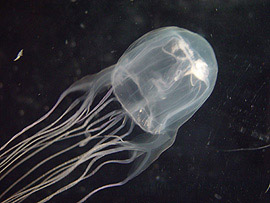
Beauty Of Animal | Sea Waps (Box Jellyfish) | Sea wasp or Box Jellyfish or Box Fish is the most poisonous sea creature than stone fish, sharks or sea snakes. Even it is a beautiful jelly, it has killed more people than other marine. Sea wasps are usually found in shallow waters. If you see sea waps at the sea, you are not allowed to do any water activites. They live in coastal waters from northern Australia and New Guinea north to the Philippines and Vietnam.
The sea wasp has a large transparent bell or cube like body and is divided into segments. They have a transparent body with a pale blue color. It has stinging tentacles. Each tentacle on a box jellyfish can have up to 5000 of these nematocysts. The box jellyfish uses these tentacles to catch its prey, example small fish and crustaceans. Box jellyfish is, unlike many other jellyfish, equipped with four eyes. Eyes are connected to a nerve ring and the creature can take evasive action or move towards its prey. Two of the eyes in the set detect only light. It has no brain, no heart and no blood.

Sea wasps feed on small crustaceans and small fish. These animals have strategy to catch their prey. They will wait for the prey to bump into their tentacles. Then, they will killed then by stinging them with their stong poison in tentacles. But, sea turtles are not affected by their sting. Sea turtle are their predator.  In most cases, the sting of the sea waps does not cause death, but it always has the potential to do so. In fact, the jellyfish, even the most venomous, releases such a small amount of venom that it rarely causes death. However, each sting can be extremely painful and requires immediate medical attention. In the cases of the worst stings, anti-venom may be applied. You can do first aid when you stinged by sea waps. First, washing the sting area with vinegar, and in no circumstance should alcohol, alcohol-based lotions, or methylated spirits be applied. Then, CPR may be required. Last, medical help should be sought as soon as possible after considering these needs.

Find Here The Kinds Of Animals and Flora and Fauna
READ MORE - Sea Waps (Box Jellyfish)